The U.S. Astronaut Hall of Fame in Titusville: 1990 opening to current operation
Established by the Mercury Seven astronauts and opened in 1990 on US-1 near Titusville, the Astronaut Hall of Fame is now part of the Kennedy Space Center Visitor Complex.
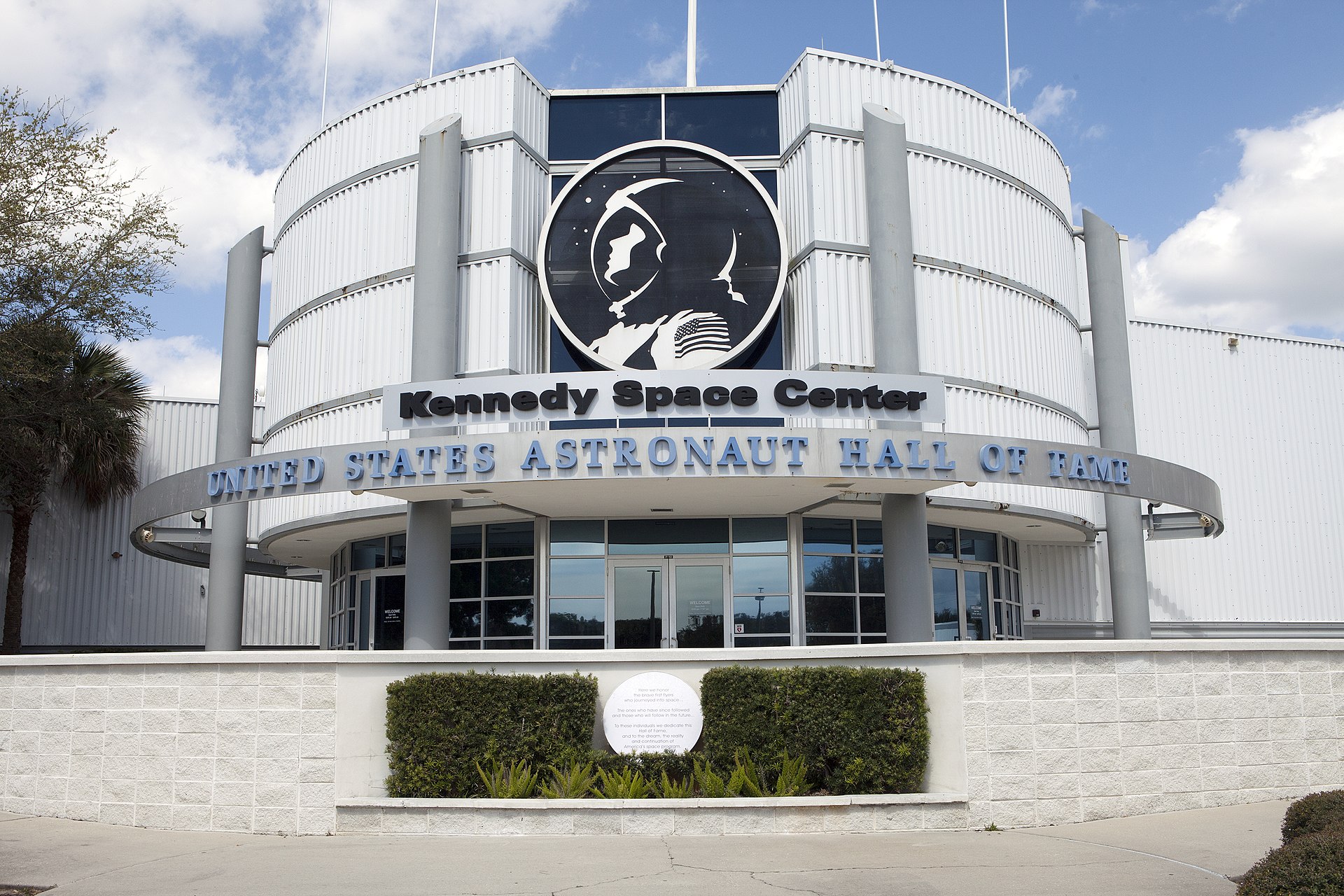
The U.S. Astronaut Hall of Fame opened on US-1 just outside Titusville in 1990. It was the institutional project of the Mercury Seven Foundation (later renamed the Astronaut Scholarship Foundation), which had been established by the surviving Mercury Seven astronauts plus Betty Grissom in 1984 as a charitable foundation funding STEM scholarships. The Hall of Fame served the dual purpose of housing the astronaut induction ceremony and generating revenue for the scholarship program.
Through the 1990s and 2000s the Titusville site operated as an independent visitor attraction. In 2002 the Astronaut Scholarship Foundation reached an arrangement with Delaware North (the concessionaire operating the Kennedy Space Center Visitor Complex) to integrate the Hall of Fame’s collection and induction ceremony into the KSC Visitor Complex’s broader program. The Titusville stand-alone facility closed in 2002 and the historical content moved to the Visitor Complex.
Who’s in the Hall
The Hall of Fame’s induction criteria require U.S. astronauts who have orbited Earth, are at least seventeen years past their first mission, and have been formally retired from active spaceflight roles for at least five years. Members are nominated and elected by a committee of existing Hall members, retired NASA officials, and historians.
The first induction class in 1990 was the Mercury Seven themselves: Scott Carpenter, Gordon Cooper, John Glenn, Gus Grissom (posthumously), Walter Schirra, Alan Shepard, and Deke Slayton. Subsequent classes have inducted Gemini astronauts (1993), Apollo astronauts (in stages from 1997 forward), Skylab astronauts (1995), and the longer arc of Shuttle astronauts in classes through the 2010s and 2020s.
By the 2020s the Hall has inducted over 100 American astronauts. The induction ceremony continues to be held at the Kennedy Space Center Visitor Complex.
The Titusville-era building
The original Hall of Fame building, visible in the period photograph used at the top of this article, was a modest mid-sized facility on US-1 near the Mosquito Lagoon side of Titusville. It included exhibition halls covering the Mercury, Gemini, Apollo, and Shuttle programs; theater spaces for film screenings; a memorabilia store; and the original induction-ceremony space.
After the 2002 closure the building was sold and went through several reuses. It is no longer a NASA-or-astronaut-related facility.
The Astronaut Scholarship Foundation
The longer-running institutional outcome of the Hall of Fame’s creation is the Astronaut Scholarship Foundation, which the original Mercury Seven Foundation evolved into. The Foundation awards merit-based scholarships to undergraduate STEM students at partner U.S. universities; it has, since founding in 1984, granted over $9 million to more than 700 scholars (per the Foundation’s own annual reports).
The Foundation’s board has historically included a rotating roster of astronauts (Mercury through Shuttle era), retired NASA officials, and prominent figures from the aerospace industry. The Foundation’s office is currently headquartered in Cocoa Beach, having moved from the original Titusville Hall-of-Fame site after the 2002 transition.
What Titusville lost in 2002
The 2002 transition was a real economic and identity loss for Titusville. The Hall of Fame had been one of the city’s flagship cultural attractions; its relocation to the KSC Visitor Complex (which sits inside Kennedy Space Center proper and is functionally part of the federal facility, not a Titusville-city institution) shifted both visitor traffic and associated revenue away from Titusville’s commercial district.
Several attempts to anchor replacement attractions in the Titusville Hall building have not succeeded at the same scale. The American Police Hall of Fame, the U.S. Space Walk of Fame Foundation, and several other smaller institutions have operated in the city; none have approached the scale of the original Astronaut Hall.
The Space Walk of Fame, on Space View Park’s walkway, is the most successful Titusville-anchored space-history institution to remain in place. It does not duplicate the Astronaut Hall’s induction function but does provide on-site mainland-Titusville recognition of the missions and astronauts.
How the Hall fits Titusville’s identity
The 1990–2002 Titusville-era Hall of Fame was the period when Titusville’s claim to “Space City USA” branding had the strongest institutional backing. The Mercury Seven themselves had selected Titusville as the Hall’s location. Buzz Aldrin, Neil Armstrong, and other Apollo astronauts had spoken at induction ceremonies in the Titusville facility.
The 2002 relocation reflected the broader commercial logic of consolidating space-tourism attractions at the KSC Visitor Complex. From a tourist’s standpoint, having one ticketed destination with all the major space-history exhibits made sense. From Titusville’s standpoint, it was another asset moving out of the city’s downtown commercial reach.
The city has adapted. Space View Park, the Indian River waterfront launch-viewing economy, and the smaller specialty museums (the American Police Hall of Fame and Museum, the Valiant Air Command Warbird Museum at Space Coast Regional Airport) carry forward different parts of the institutional identity. None of them, individually, match what the Astronaut Hall represented in its 1990–2002 prime.
The Mercury Seven Foundation’s founding moment
The Mercury Seven Foundation, the parent organization that built the Hall, was incorporated in 1984 by the six surviving Mercury Seven astronauts plus Betty Grissom, widow of Gus Grissom. Per the Astronaut Scholarship Foundation’s own historical record, the impetus was conversation among the Mercury Seven at a reunion: they had collectively benefitted from the public investment in space, and they wanted a vehicle to return that benefit to American STEM education. The Foundation’s original board was Scott Carpenter, Gordon Cooper, John Glenn, Walter Schirra, Alan Shepard, Deke Slayton, and Betty Grissom.
The choice of Titusville for the Hall building was a deliberate Mercury Seven decision. Several Florida cities lobbied for the institution; the astronauts picked Titusville for the same reason most Apollo and Mercury launches had originated across the lagoon, the visible adjacency to Cape Canaveral and the symbolic continuity with the early-program landscape. Buzz Aldrin and other Apollo-era astronauts, while not founders of the Foundation, supported the Titusville location and spoke at early induction ceremonies.
The Foundation’s scholarship program began in 1986, two years after incorporation and four years before the Hall building opened. Early scholarships were funded through donations from the Mercury Seven themselves, supplemented by airshow appearance fees and the proceeds of an annual gala. By the time the Hall opened in 1990, the scholarship infrastructure was already in place, the building was meant to add a tourist-revenue stream on top of the donation base, not to replace it.
The Hall as institutional memory
For the broader question of how astronaut history is preserved and presented to the American public, the Astronaut Scholarship Foundation’s continued operation is the bigger story than the building’s relocation. The scholarship program’s longevity, its connection to the original Mercury Seven, and its endowment growth through the 2000s and 2010s have given it institutional durability beyond what a single building could provide.
The induction ceremony continues. The scholarships continue. The Hall’s collection is preserved and exhibited at KSC Visitor Complex. The Titusville chapter of the institution’s history closed in 2002, but the institution itself is intact and active.
Further Reading
As an Amazon Associate we earn from qualifying purchases.