Space View Park and the public launch-viewing tradition
Established by the City of Titusville for public launch viewing across the Indian River, Space View Park has been the mainland's most-used vantage point on Pad 39A for over thirty years.
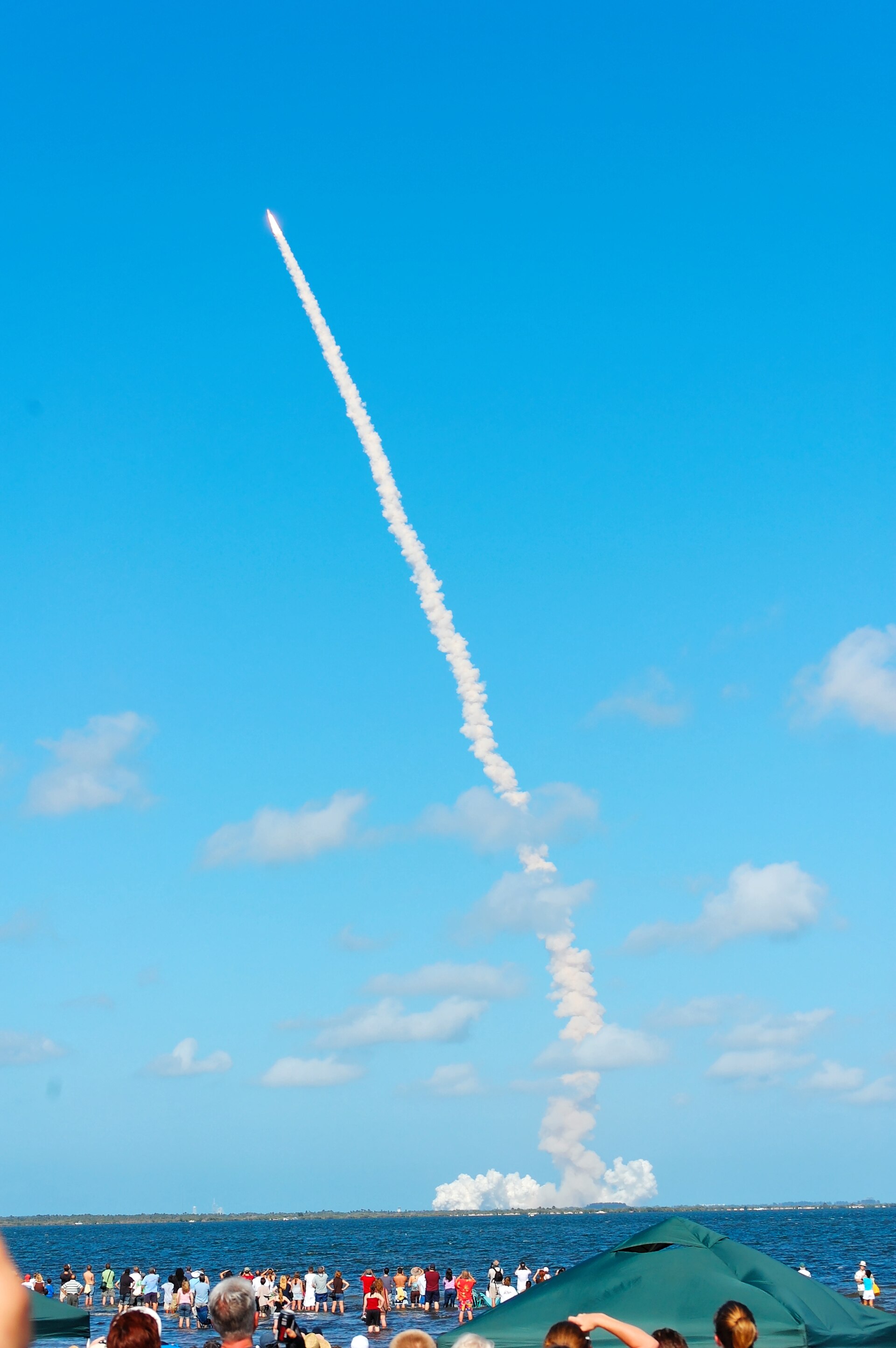
Space View Park sits on the west shore of the Indian River Lagoon at downtown Titusville, on Broad Street between Indian River Avenue and the lagoon. From its waterfront vantage, Pad 39A is in direct line of sight across approximately thirteen miles of water and barrier island. The park has been the City of Titusville’s primary public launch-viewing site since its establishment in the early 1990s; informal use of the same waterfront for launch viewing dates back to the early 1960s.
The site is also a memorial. Bronze plaques set into the park’s lagoon-facing walkway commemorate the Mercury, Gemini, Apollo, Skylab, Apollo–Soyuz, and Shuttle missions, with names of mission commanders, mission patches, and key dates. The Apollo memorial section was dedicated in 1995; the Shuttle memorial section was completed in stages through the 2010s after the Shuttle program ended.
Why this exact vantage point
The geometry matters. Pad 39A sits roughly thirteen miles east of Titusville’s downtown lagoon front, with the Indian River and the Banana River intervening. The barrier island (Merritt Island and the southern Mosquito Lagoon spit) is the closest land mass between the viewer and the pad. From most points on the Titusville waterfront the pad’s gantry is visible during launch operations; during a launch, the vehicle’s plume is unmistakable.
Other Brevard County vantage points exist for launch viewing. Playalinda Beach (north of KSC, accessed through Canaveral National Seashore) gives the closest mainland-side view but requires a long drive through unincorporated land. Jetty Park at Port Canaveral gives a good south-of-pad view of Cape Canaveral Air Force Station pads but is south of 39A and 39B. Cocoa Beach is the traditional tourist-launch-viewing town but its angle is south of pad and is obscured by the southern KSC complex.
Space View Park’s relative advantage is mainland access, proximity, and a direct east-facing line of sight. For most casual launch tourists who don’t want to drive north to Canaveral National Seashore or pay for a KSC Visitor Complex viewing pass, Space View Park is the default.
The park’s development
The lagoon-front lot that became Space View Park was originally part of the Titusville downtown commercial waterfront, with several older commercial structures occupying the site through the early 20th century. By the 1980s the city had acquired the parcel and was operating it informally as public open space.
The formal park dedication came in 1992, with the first bronze memorial plaque installations following over the next several years. The City of Titusville Parks and Recreation Department maintains the park; Brevard County contributed several capital improvements through the 2000s including walkway expansion and lighting upgrades.
The park’s amenities are modest: paved walkway, seating areas, the bronze memorial plaques, a small parking lot, and accessible pier infrastructure. There is no entry fee. During major launches the park reaches capacity hours in advance; the city manages traffic and parking through temporary closures of adjacent streets.
The memorial plaques
The bronze plaques set into the park’s walkway are the park’s most distinctive feature. Each plaque records a single mission with mission patch, crew names, mission dates, and a brief contextual notation. The memorial system was conceived in the late 1980s as a way to recognize the broader human history of crewed American spaceflight in the place that had served as its closest mainland viewing point.
Apollo 1 (the January 1967 fire that killed Gus Grissom, Ed White, and Roger Chaffee), Challenger (STS-51-L, 1986), and Columbia (STS-107, 2003) are each memorialized with appropriately contextual plaques. The park includes a separate memorial structure for the Apollo 1 astronauts that pre-dates the broader memorial program.
The park’s role as a memorial site is significant in Brevard County’s identity. Many Titusville residents have direct or family connections to the NASA workforce through Apollo, Shuttle, or commercial space. The Challenger disaster in particular hit Brevard County personally: many of the schoolchildren watching from Brevard schools that morning had parents or neighbors employed by NASA Kennedy or Shuttle contractors.
The launch-day experience
A launch from Pad 39A is, from Space View Park, primarily a visual and (delayed) acoustic event. The sound takes roughly a minute to travel the thirteen-mile distance; viewers see the launch first, hear it about a minute later, and feel the low-frequency rumble through the ground for longer. Saturn V launches in the Apollo era reached ground-shaking magnitudes audible thirty miles away. Shuttle launches were smaller acoustically but still produced a distinct multi-tone rumble. Falcon 9 launches in the 2020s era are smaller still; Falcon Heavy launches approach Shuttle-scale acoustically.
The park fills hours before scheduled launches. Locals bring chairs and coolers. Visitors from across the country and abroad come for high-profile launches. Crewed launches (Demo-2 in May 2020 and subsequent SpaceX Crew Dragon missions) have drawn the largest crowds since the Shuttle era.
Launches viewable from Space View Park since 1992
Putting numbers around what the park has actually witnessed: between the 1992 dedication and the end of the Space Shuttle program in July 2011, KSC launched roughly 110 Shuttle missions visible from the park. The dedication ceremonies for the Apollo memorial section in 1995 coincided with the early-to-mid Shuttle era, with STS-67, STS-71 (the first Shuttle-Mir docking), and STS-74 among the launches visible during the memorial’s first calendar year of operation.
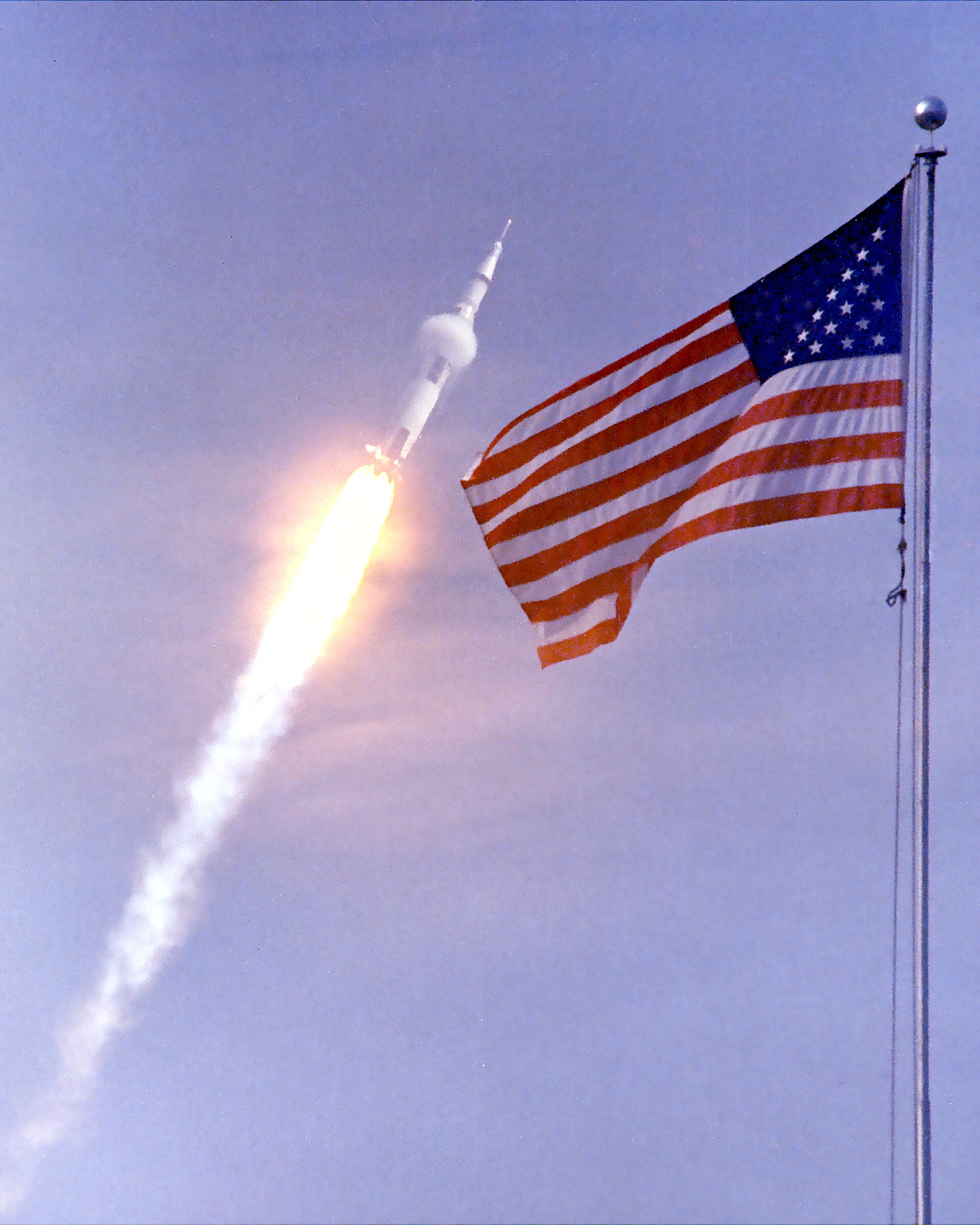
The post-2011 era brought a different launch cadence. Commercial cargo missions to the International Space Station (SpaceX Dragon and Northrop Grumman Cygnus) began in 2012 from Cape Canaveral pads visible from Space View Park. SpaceX took over Pad 39A in 2014 and began Falcon 9 operations from the same pad that launched Apollo 11. The first crewed Dragon mission, Demo-2, lifted off May 30, 2020 with NASA astronauts Doug Hurley and Bob Behnken, the first crewed launch from U.S. soil since STS-135 in 2011 and the largest crowd Space View Park had drawn since the final Shuttle launch.
The park has continued to fill for subsequent SpaceX Crew Dragon missions, Falcon Heavy launches, and high-profile commercial launches. Through the 2020s the launch cadence from Cape Canaveral and KSC pads has averaged more than 50 launches per year, the highest sustained launch rate from any single coastal region in the world. Space View Park’s role as the mainland’s default viewing site has become busier, not less so, in the post-Shuttle decade.
What the park represents for Titusville’s identity
A small Florida city makes its identity from what it can credibly claim. Titusville cannot credibly claim to be a beach-resort town (the lagoon is not a beach); it cannot credibly claim to be a major cultural center (the population isn’t there); it cannot credibly claim to be a sports town. What Titusville can credibly claim is to be the place where Americans go to watch their country leave the planet.
Space View Park is the physical expression of that claim. The plaques memorialize the missions; the geometry of the site is what made the viewing possible; the city’s commitment to maintaining and expanding the park reflects an institutional decision to preserve the identity through the post-Apollo and post-Shuttle decades when the contractor workforce shrank and the commercial premise of the town shifted.
For the next thirty years of launch operations at 39A under SpaceX and whoever else operates from the pad, Space View Park will continue to be where the mainland watches. The site is unchanged from what it was in 1969 when Apollo 11 lifted Saturn V off the same pad to the moon, and what it was in 2011 when Atlantis closed the Shuttle program in the same direction.
Further Reading
As an Amazon Associate we earn from qualifying purchases.